

Latest Trends in Metal 3D Printing
At Formnext in Frankfurt in November 2025, the exhibition area expanded significantly, reflecting the rapid growth of additive manufacturing technologies. Large-scale plastic 3D printing attracted particular attention, with systems capable of producing components several metres in length. These machines are equipped with massive material deposition heads designed to improve processing time efficiency.
Alongside plastics, metal 3Dprinting was also strongly represented. Several world-leading beam-based metal AM manufacturers showcased their latest machine configurations. As processing chamber sizes continue to increase, complete machine installations now approach the size of a studio room or even a double story room. To enhance productivity, many systems employ multiple beam sources—typically synchronised four to eight beams operating. Beam-based AM manufacturers are also focusing on very large components that cannot be enclosed within a chamber, such as jet engine skirt parts with diameters of several metres.
Precise small metal parts production in AM technology
For smaller and higher-precision metal components, sinter-based additive manufacturing is emerging as a promising solution. Unlike beam-based AM, layer thickness can be reduced in proportion to metal powder particle size, enabling the fabrication of finer designs with high dimensional accuracy. In addition, the availability of fine spherical metal powders has increased significantly, thanks to intensive investment by metal powder manufacturers in gas atomisation facilities.
Sinter-based AM technology
Sinter-based AM produces green parts during the printing stage and can be broadly categorised in to three process types: powder bed, fused deposition, and vat photopolymerisation.
Powder bed systems can be further divided into two types depending on whether the metal powder is pre-coated or not. It is widely used photosensitive and thermosetting polymers as a coating materials. Printing is carried out using optical light or low-power lasers, depending on the coating material. In contrast, non-coated metal powders are used in binder jetting processes, where the binder is precisely deposited according to the cross-sectional design. While this approach also uses pure metal powder, similar to beam-based AM, it allows the use of much fine powders. Furthermore, binder-jetted green parts contain the lowest binder content among sinter-based AM processes, enabling significantly shorter debinding times.
Fused deposition, or fused filament fabrication, supplies feedstock only to the required regions of the component, making it one of the most economical AM methods from a material utilisation perspective. The feedstock in wire form consists of metal powder and a thermoplastic binder. Unlike metal injection moulding(MIM) feedstock pellets, the filament must possess sufficient flexibility for reeling, while also maintaining adequate stiffness to support cantilevered or spanning structures. The maximum unsupported hanging length, while maintaining parallelism to the build platform, is one key indicator used to evaluate filament fabrication technology. However, the gap between the fused lines and layers is tending large.
Vat photopolymerisation is similar to the powder bed approach in that each printing layer must be uniformly spread across the building area. The feedstock consists of metal powder and photosensitive binder, resulting in relatively high viscosity and it uniformly spreads across the build platform using a blade. Layer thickness can be adjusted according to metal powder particle size, with finer powders enabling thinner layers. A significant advantage of the vat process is that support structures are not required, owing to the inherent viscosity of the feedstock. Additionally, the spot size of the polymerisation can be small in a single micron range, thus high precision printing without minimal post-machining is capable. Importantly, the printing layer gap is also minimal in sinter-based AM, thus, the dense sintered parts, equivalent to MIM, are readily available.
Our μ-MIM technology offers abridge between AM and MIM
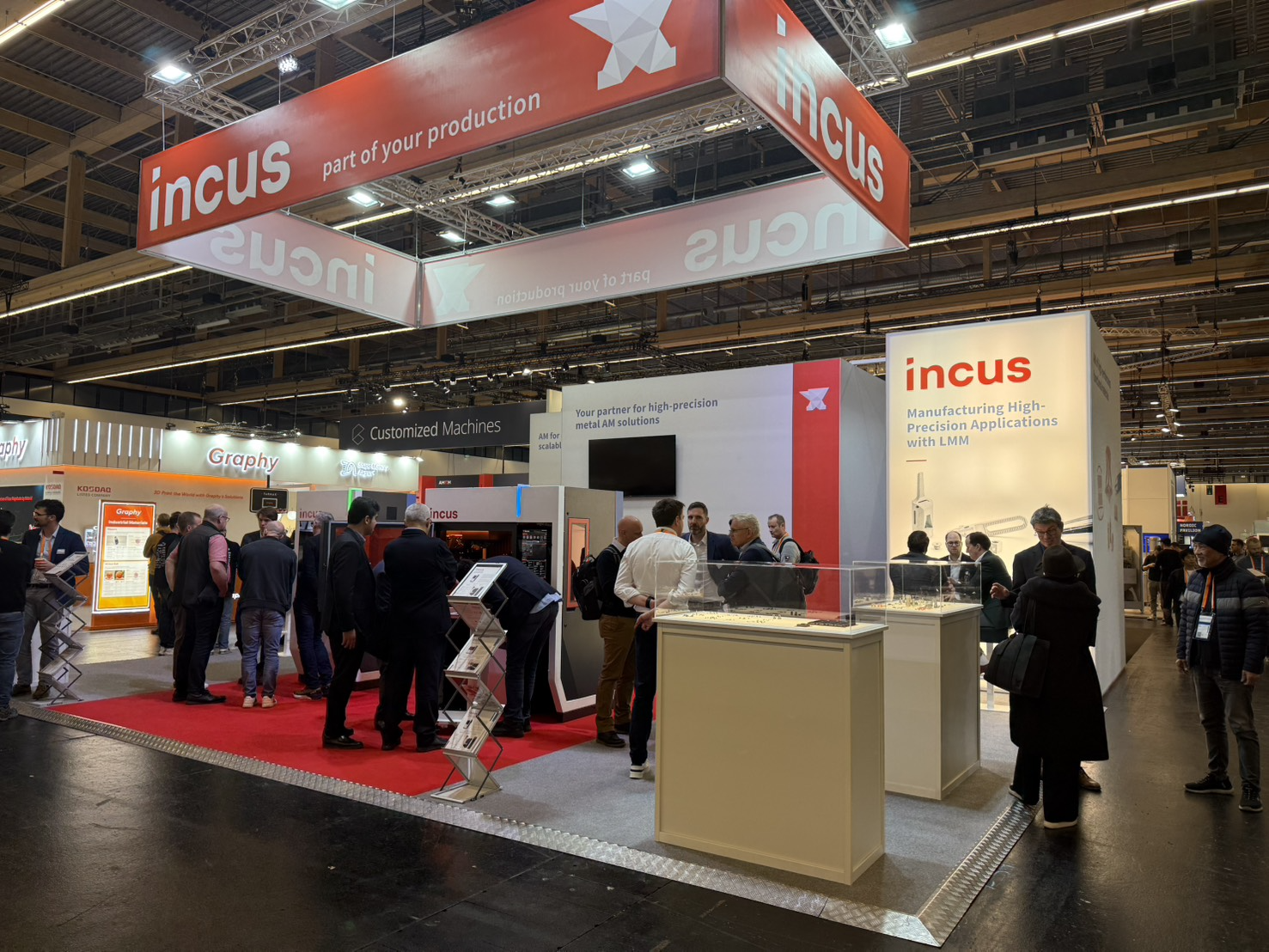
We have deployed a vat photopolymerisation system from Incus for prototyping applications, due to its high precision and high density. Importantly, this process allows us to use exactly the same metal powders as those employed in our MIM serial production. If you are interested in transitioning high-precision metal parts from prototyping to serial production, please feel free to contact us.
Upcoming Exhibitions
MD&M West 2026 Feb 3–5 | Anaheim | Booth #3499
Medtec Japan 2026 Apr21–23 | Tokyo | Hall E7- Booth #309/#409
Download the PDF file
Conclusion
Cracking, slumping or blistering is commonly observed due to the binder swelling and/or residual stress difference between the surface and interior. It is possible to avoid these problems by selecting appropriate organic solvents and temperature control.
The catalytic deboning uses sublimation of binder, thus it is possible to decompose the binder in relatively short processing time with minimizing the deformation. However, with a strong acidic atmosphere, theapplicable metal material option is limited.
In the sintering process, the necking, which is bridging the metal powders by thermal diffusion, starts at the sintering temperature. Once the necking starts, the shrinking is observed and increases the density, thus before starting the necking reaction, all the organic components should be decomposed and gas between the powders should be removed. In the sintering process, the unwanted chemical reaction, such as oxidation or carbonization, leads to mechanical property loss, therefore a precise atmosphere control with low heating rate at the beginning of the process is required. Also, when it reaches the sintering temperature, some add it vegetal can be evaporated.